

Since its official debut in 2013, Salesforce Marketing Cloud has evolved into one of the company’s most comprehensive product suites. What began as a single marketing platform has expanded into an ecosystem of solutions that includes Marketing Cloud Engagement, Marketing Cloud Account Engagement (formerly Pardot), Marketing Cloud Intelligence, and several other specialized applications.
For years, Marketing Cloud Engagement has been the foundation of Salesforce’s digital marketing offering. As the platform faces slowing growth, however, questions are emerging about its long-term direction. Is Marketing Cloud Next the next chapter in Salesforce’s marketing strategy, or is the company preparing for a broader transformation?
The Journey of Salesforce Marketing Cloud
Marketing Cloud exists today largely because of Salesforce’s acquisition strategy. The company assembled the platform through several major purchases, most notably Radian6, Buddy Media, and ExactTarget, investing nearly $3.5 billion to establish its marketing technology portfolio. Over time, Salesforce expanded the platform further by integrating additional acquisitions such as Evergage and Datorama.
In 2022, Pardot was officially renamed Marketing Cloud Account Engagement (MCAE). The objective was to create a more consistent naming convention across Salesforce’s expanding ecosystem. While logical from a branding perspective, the change introduced new confusion for customers trying to distinguish between Marketing Cloud Engagement (MCE) and Marketing Cloud Account Engagement (MCAE).
In 2024, Salesforce launched Marketing Cloud Growth (MCG), a solution designed specifically for small and mid-sized businesses and built directly on Salesforce Core. Later that same year at Dreamforce, the company introduced Marketing Cloud Advanced (MCA), offering a broader feature set for organizations with more sophisticated marketing requirements.
The evolution continued in 2025 with the introduction of Marketing Cloud Next.
Rather than simply adding another product, Marketing Cloud Next represents Salesforce’s effort to unify its marketing ecosystem. Built on Salesforce Core, Data 360, and Agentforce, the platform enables AI-powered marketing agents to operate across the entire Salesforce ecosystem instead of remaining isolated within marketing workflows. This architecture is intended to connect customer data, automation, and AI more seamlessly than previous generations of Marketing Cloud.
Slowing Revenue Growth Raises Questions
Despite continued product innovation, Marketing Cloud’s financial performance has shown signs of weakness.
Beginning in fiscal year 2024, revenue growth within Salesforce’s Marketing & Commerce business became increasingly inconsistent. Growth reached 7.4% in Q1 FY24 before accelerating into double digits at 10.4% during Q2. That momentum, however, proved short-lived, with growth slowing throughout the remainder of the year.

Its strongest performance afterward came in Q1 FY25, when growth reached 9.6%. By Q3, growth had eased before recovering slightly to 8.5%, only to enter another prolonged decline. By Q4 FY26, Marketing & Commerce growth had fallen to just 1.5%, representing one of the weakest performances the segment has experienced since Marketing Cloud became a core part of Salesforce’s business.
Although Salesforce renamed several service categories around Agentforce in Q3 FY26, the company stated that these branding changes did not affect revenue allocation or financial reporting.
The reporting structure changed more significantly in the company’s latest earnings release.
Instead of reporting Marketing & Commerce as an independent business segment, Salesforce combined Agentforce Sales, Service, Marketing, Commerce, Slack, and Flex Credits into a broader category called Agentforce Apps.
Because of this reporting change, investors can no longer directly measure standalone Marketing & Commerce performance in FY27. Nevertheless, management acknowledged that first-quarter results were “partially offset by softness in commerce” and noted that its FY27 outlook assumes continued weakness across both marketing and commerce businesses.
Macroeconomic Pressure Meets Product Transition
The slowdown is not necessarily unique to Salesforce.
During periods of economic uncertainty, marketing budgets are often among the first expenses companies reduce. That pattern reflects broader macroeconomic conditions rather than the competitiveness of any single product.
Even so, economic pressure also creates opportunities for vendors capable of delivering measurable business value.
Salesforce continues to possess one important competitive advantage: real-time, data-driven personalization powered by unified customer data. As AI becomes increasingly central to marketing operations, the company still has the potential to differentiate itself—provided customers can clearly realize the value of these new AI capabilities.
The commerce business also deserves consideration.
Because Marketing Cloud is reported together with Commerce, performance reflects both businesses. Salesforce has recently expanded its portfolio of AI-powered commerce agents, deploying solutions for major brands including Williams-Sonoma. While early demonstrations left room for improvement, many expect these capabilities to mature significantly before the next Dreamforce conference.
What’s Really Happening to Marketing Cloud Engagement?
Speculation around the future of Marketing Cloud Engagement (MCE) intensified after reports suggested Salesforce might be reducing investment in its long-standing marketing automation platform. Given the company’s increasing focus on AI and Agentforce, many customers questioned whether MCE was approaching the end of its lifecycle.
The company maintains that Marketing Cloud Engagement remains an actively supported product, with continued investment in new functionality. Recent releases include the Marketing MCP Server for MCE, along with several interoperability features introduced in the Summer ’26 release. These enhancements include shared sending domains, shared SMS short codes, unified consent management, and cross-platform AMPScript support between Marketing Cloud Engagement and Marketing Cloud Next.
According to information shared by SF Ben, existing MCE customers are not being asked to abandon their current environments. Instead, Salesforce is extending those implementations with Agentforce capabilities through Marketing Cloud Next. Customers can continue using familiar functionality while gaining access to AI-powered features and a clearly defined upgrade path on Salesforce’s latest platform.
Is Marketing Cloud Next the Future?
Artificial intelligence has rapidly become the centerpiece of Salesforce’s product strategy, and Marketing Cloud is no exception.
Marketing Cloud Next represents Salesforce’s attempt to redefine enterprise marketing by combining customer data, automation, and AI agents within a single platform. Rather than functioning as another edition of Marketing Cloud, Next is positioned as an entirely new generation of marketing technology.
Salesforce describes it as “the first full-funnel agentic marketing solution that turns every channel into a two-way conversation.”
The platform combines Agentforce with Data 360 to enable AI agents to orchestrate customer engagement across sales, service, commerce, and marketing. This broader integration reflects Salesforce’s long-term vision of eliminating silos between business functions and allowing AI to coordinate customer interactions across the entire CRM ecosystem.
From that perspective, Marketing Cloud Next appears less like an additional product and more like the eventual destination for Salesforce’s marketing portfolio.
Whether Marketing Cloud Engagement ultimately disappears or simply evolves into part of the new platform remains uncertain. However, Salesforce’s investment priorities increasingly suggest that Marketing Cloud Next will become the company’s primary marketing offering over time.
Could Other Product Areas Face Similar Challenges?
Marketing Cloud isn’t the only area experiencing change.
Recent workforce reductions at Salesforce also affected teams across Marketing Cloud, Agentforce, and MuleSoft. Regulatory filings in California indicated that approximately 86 employees from these organizations were impacted during the latest round of layoffs.
Financial results also reveal shifting momentum across Salesforce’s product portfolio.
In Q1 FY27, the newly reported Agentforce Marketing and Agentforce Commerce category recorded negative year-over-year growth for the second consecutive quarter, making it the only major business segment to contract.
By contrast, the Agentforce 360 Platform, Slack, and Other category delivered an impressive 43% growth rate.
That figure should be interpreted carefully, however. Salesforce groups several rapidly growing businesses—including Data 360 and Informatica—within this category, making it difficult to determine the contribution of each individual product. Even so, inclusion alongside Salesforce’s strategic AI platform suggests these products remain central to the company’s long-term roadmap.
Other core CRM products continue to perform relatively well.
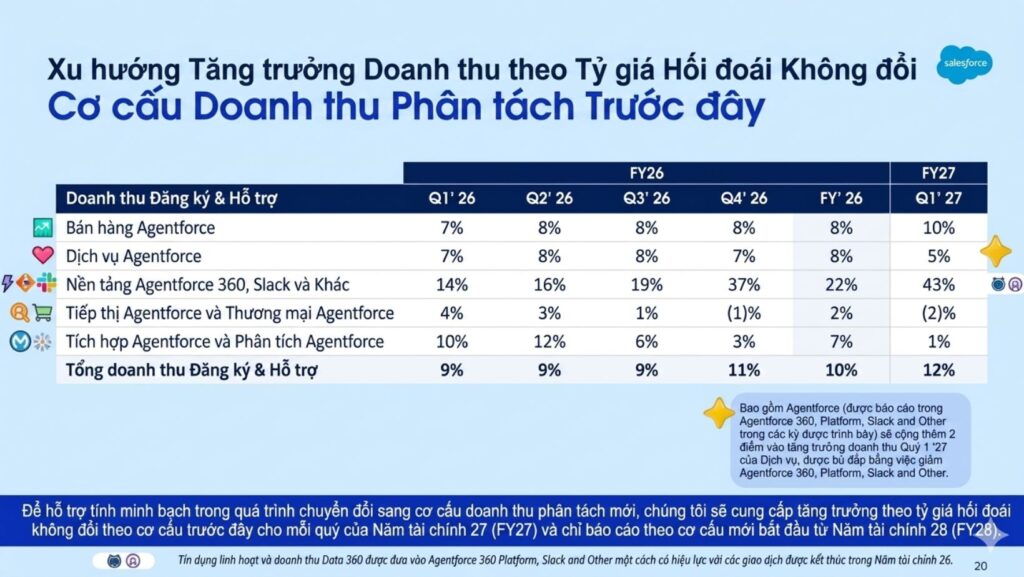
Agentforce Sales reported 10% revenue growth during Q1 FY27, while Agentforce Service grew by 5%. Although Service has experienced modest slowing over recent quarters, both remain foundational products that are expected to receive continued investment.
A less encouraging picture emerges for Agentforce Integration and Agentforce Analytics.
Revenue growth for that category declined to just 1% in Q1 FY27 after reaching 12% only three quarters earlier. While Salesforce is unlikely to significantly reduce investment in products carrying the Agentforce brand, the recent layoffs demonstrate that even strategic product groups are not immune to organizational restructuring.
Final Thoughts
Salesforce continues to expand the capabilities of Marketing Cloud, particularly through AI-powered innovations and Marketing Cloud Next. However, stronger technology has not yet translated into stronger financial performance.
Slowing revenue growth, changing reporting structures, and ongoing organizational adjustments all point to a business in transition rather than one in decline. Marketing Cloud remains an important part of Salesforce’s ecosystem, but its future increasingly appears tied to the success of Agentforce, Data 360, and the company’s broader AI-first strategy.
Over the coming quarters, customers, partners, and investors will be watching closely to see whether Marketing Cloud Next can successfully reignite growth—or whether Salesforce will need to rethink how its marketing business evolves in the years ahead.
Source: salesforceben
Request a Salesforce Marketing Cloud Quote and Implementation Consultation
Every business has unique marketing strategies, operational processes, and growth objectives. As a result, the right Salesforce Marketing Cloud solution and the associated licensing and implementation costs will vary based on your organization’s specific requirements.
Nimbus Consulting helps businesses:
- Conduct a complimentary assessment of your business needs and current system landscape.
- Recommend the most suitable Marketing Cloud solution, including Marketing Cloud Engagement, Marketing Cloud Account Engagement, Marketing Cloud Growth, or Marketing Cloud Next.
- Provide a tailored estimate for licensing and implementation costs based on your business size and requirements.
- Develop a phased implementation roadmap and integration plan with your existing Salesforce ecosystem.
- Advise on CRM investment strategies to maximize ROI and optimize your Marketing Cloud deployment.
Get in touch with the Salesforce experts at Nimbus Consulting today to receive a customized quote and implementation plan tailored to your business goals.
☎ Hotline: (+84) 812 014 918
🌐 Website: nimbus-consult.vn

 Ho Chi Minh City Office: 68 Bat Ban, Binh Trung Ward, Ho Chi Minh City