

AI coding is helping developers write, fix, and test code faster. But much of that experience still happens in private sessions between one person and an AI agent. The rest of the team often sees the result only after the work has already progressed.
Salesforce introduced Slack Code to change that model. Instead of keeping AI in a separate tab, Slack Code brings agents directly into the team’s shared workspace, where people can follow the work, add context, review changes, and approve outcomes together.
What makes Slack Code interesting, then, is not simply its ability to support coding. It reflects a broader shift in how Salesforce is bringing AI into everyday workflows rather than treating it as a separate tool.
What Is Slack Code?
Slack Code is a collaborative experience for software development inside Slack. At the center of the experience is the code channel — a dedicated channel tied to a specific project or task.
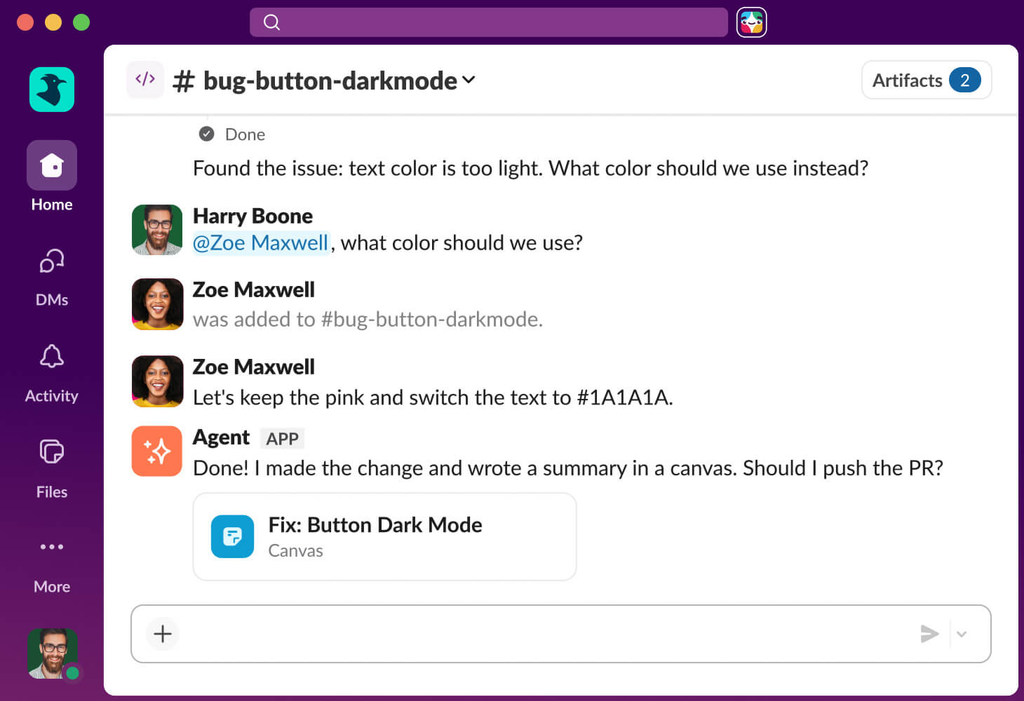
When a user calls a coding agent from Slack, a code channel can be created for the team and the agent to work together. Within the same space, users can follow conversations, implementation plans, code diffs, documents, working builds, and live previews.
Once the task is complete, the channel can automatically archive while its history remains searchable for future reference. According to Slack, more than 70% of code channels are opened and closed within a single day, from the initial idea to a merged pull request.
This suggests that code channels are designed around clearly scoped tasks: they open when needed, provide a focused space for the work, and close once the task is complete.
How Does Slack Code Change the Way Teams Work With AI?
In a traditional AI coding workflow, the process is often straightforward: a developer opens an AI tool, provides instructions, works with the agent, and then shares the result with the rest of the team.
The challenge is that much of the context and execution stays between the developer and the agent. A product manager may not know what assumptions the agent is making. A designer may only see the change once the interface is nearly finished. Another engineer may only become involved during the final review.
Slack Code brings that process into a shared space. One person can still initiate the task, but relevant teammates can participate while the work is happening rather than waiting until the end.
A product manager can add requirements. A designer can review the preview. An engineer can assess technical changes. If the agent starts moving in the wrong direction, the team can step in before the work goes further.
This is the idea behind what Slack calls multiplayer work: AI is no longer only helping one individual work faster; it becomes part of how the entire team collaborates.
Why Use a Code Channel Instead of a Thread?
Threads work well for quick conversations. But a software development task can involve multiple rounds of code changes, documents, previews, and feedback. When all of that is packed into a single thread, the work can quickly become difficult to follow.
A code channel creates a dedicated space for each task. Teams can monitor progress, review changes, and check results without overwhelming their main channels.
More importantly, the code channel preserves the context of the entire process. If the team needs to revisit a decision or understand why a change was made, the history remains available instead of having to reconstruct information from multiple tools and conversations.
AI Can Act, but People Still Make the Final Decision
Slack Code is not designed around handing the entire task to AI and simply waiting for the result.
Teams can follow the process, pause an agent, or redirect it when needed. For higher-risk changes, such as deploying code to production, the work can be routed to an appropriate expert for review and approval before it moves forward.
This becomes increasingly important as AI agents move beyond answering questions and begin carrying out multiple steps within a task.
For businesses, the question is no longer simply, “Can AI do this?” More practical questions are: What is the AI allowed to do? Who can review its work? And who remains accountable for the final decision?
Slack Code brings those control points into the same environment where the work takes place.
Security and Governance Inherit Slack’s Existing Controls
Another advantage of Slack Code is that businesses do not need to build an entirely new control layer just to bring agents into their workflows.
Code channels use Slack’s existing permissions and administrative controls. Agents can only access content they are authorized to see.
Slack also states that interactions with agents can fall under enterprise security mechanisms such as Enterprise Key Management, Data Loss Prevention, and Discovery APIs.
This is particularly important for larger organizations. AI can accelerate work, but enterprise adoption still requires clear access controls, visibility, and traceability.
Slack Code Helps Reduce Fragmentation in Software Development
Software projects often span multiple tools. Requirements may live in documents, conversations happen in Slack, code sits in GitHub, and previews may exist in a separate environment.
Slack Code does not replace those tools. Instead, it brings the collaborative layer between them closer together.
For example, a product manager can flag a bug in Slack and call an agent for help. The agent can propose a change, an engineer can review the code diff, and the team can inspect the preview before a pull request is opened.
Non-technical team members can also get involved earlier by describing an issue, adding requirements, or reviewing the result without having to follow the entire coding process.
The value is not in making software development simple. It is in reducing the disconnect between people, tools, and information.
Slack Is Not Betting on a Single AI Agent
Slack Code is being built as an open experience that works with multiple AI partners.
Salesforce has announced partners including Anthropic, Cognition, GitHub, OpenAI, and Vercel, while Slack continues to expand the range of agents that can participate in the experience.
Different platforms can play different roles. Claude or Devin can help handle coding tasks, GitHub Copilot can support development and code review, while Vercel can generate previews for teams to evaluate the result.
What is notable is that Slack is not trying to become another coding agent. Its intended role is broader: to become a collaboration layer where people, agents, and tools come together.
That approach reflects the reality of enterprise technology, where very few organizations are likely to rely on a single model or AI platform across every department.
Slack Code Is Part of a Broader AI Strategy
Slack Code does not stand on its own.
Slack is also developing an Agents tab, where users can monitor agents and active sessions, as well as see when an agent requires human input. APIs for agents are also being developed to support more customized experiences within Slack.
More broadly, Slack Code fits into the direction Salesforce has been pursuing in recent years.
Slack Channels bring Salesforce data into conversations. Slackbot is increasingly becoming an interface for interacting with systems. Slack CRM brings CRM tasks closer to where teams are already communicating. Slack Code extends that same approach into software development.
The common thread is that Salesforce is bringing data, AI, and action closer to the place where users already work every day.
As a result, Slack is becoming less like a tool used only for messaging and more like an interface where work actually gets done.
How Is Slack Code Available Today?
Salesforce says Slack Code is available across all Slack plans.
However, businesses still need the appropriate access to individual partner services, such as Claude, Devin, GitHub Copilot, ChatGPT, or Vercel agents.
Specific availability may also vary depending on region, account type, and the terms of each service.
So while Slack Code itself is available across Slack plans, that does not mean every related agent or capability is automatically included or available at no additional cost.
Why Does Slack Code Matter for Businesses?
Slack Code is not the first tool to use AI for writing code. What makes it notable is how it changes where AI sits within the workflow.
AI is no longer confined to a private session visible to only one person. The agent is brought into a shared environment where context, access controls, review processes, and human accountability already exist.
That reflects a broader shift in enterprise AI.
In the early stage, the main question was often which model was more powerful. As AI becomes more deeply embedded in business operations, the more important questions become: Is AI being placed in the right workflow? What is it allowed to access? And how do people remain in control?
Slack Code is a clear example of that shift.
Software Engineering May Only Be the Starting Point
For now, Slack Code is focused on software development. However, the collaboration model between teams and agents could extend further as Slack opens more APIs and customization capabilities.
An agent could help a marketing team prepare content for review, support legal teams by reading documents and flagging risks, or help IT handle repetitive tasks before routing critical steps to people for approval.
Not every workflow needs a “code channel.” But the principle behind Slack Code can apply more broadly: bring the agent into the same context as the people doing the work, so AI can support execution without being separated from oversight.
Source: Slack, Introducing Slack Code: Agentic Coding for Teams
Conclusion
Slack Code matters not because Salesforce has created another AI coding tool. The market already has plenty of those.
The difference is that Slack brings the AI agent directly into the place where the team is already working.
When conversation, context, agents, review, and approval exist within the same flow, AI no longer becomes a tool people have to leave their work to use. It becomes part of the workflow itself.
For businesses, that may represent a more meaningful shift than simply adding another AI tool.
The next question is no longer “Are we using AI?” but rather “How is AI participating in the way our organization works?”
Bring AI Into the Right Business Workflow
The value of AI does not come only from the capabilities of a model or agent. It also depends on how that technology connects with existing workflows, data, and governance.
With experience across Salesforce, Slack, and AI solutions, Nimbus Consulting helps businesses identify high-value use cases, design how AI should participate in workflows, and build an implementation roadmap aligned with real operational needs.
Talk to Nimbus to explore where AI agents can create measurable value across your Slack and Salesforce workflows.
(+84) 812 014 918
68 Bat Nan Street, Binh Trung Ward, Ho Chi Minh City, Vietnam

 Ho Chi Minh City Office: 68 Bat Ban, Binh Trung Ward, Ho Chi Minh City