

AI that can answer questions is no longer new.
The more important question for businesses right now is:
Can AI actually work on a business’s data, processes, and systems?
On August 26, 2026, Salesforce and Anthropic announced Claudeforce — a partnership combining Claude’s reasoning capabilities with Salesforce’s enterprise data, workflow, business logic, actions, and governance.
Looked at purely from a technology angle, this is a combination of a powerful AI model and a CRM platform.
But looked at from a business angle, Claudeforce points to a bigger shift:
AI is moving from helping people find answers to understanding context, supporting decisions, and carrying out work within permitted boundaries.
This is what’s really worth paying attention to.
1. Claudeforce is not just an AI integration
To understand Claudeforce, it helps to start with what each side brings to the table.
Claude brings reasoning capability: analyzing information, understanding context, reasoning through, and handling complex requests.
Salesforce brings what AI cannot create on its own: CRM data, business context, workflow, business rules, access permissions, and governance.
When these two components come together, the goal is no longer just: Ask → Answer
but moves toward: Understand → Reason → Decide → Action
For example, instead of just asking: “Where does this deal stand?”
A user can make a more work-oriented request:
“Review this deal, identify the key risks, and prepare what’s needed for the next meeting.”
To fulfill that request, the AI needs to understand context, access the right data, reason over that information, and determine the next action.
That is exactly the gap between an AI Assistant and an Agentic AI.
2. Salesforce in Claude: When AI Starts Working with the CRM
One of the first products under Claudeforce is Salesforce in Claude — a plugin that brings Salesforce into Claude, designed for sales teams.
Salesforce says the product launches with 37 prebuilt sales skills, covering many tasks across the revenue cycle, including:
Preparing for customer meetings
Reviewing deal health
Reviewing pipeline
Analyzing revenue context
Updating pipeline
Carrying out permitted actions within Salesforce
However, the 37 skills are not the most notable part.
What matters more is how these capabilities can change the sales workflow.
Traditional workflow
A familiar process might look like this:
Open Salesforce → find the account → read through history → check the opportunity → gather information → prepare for the meeting → go back to the CRM to update
A lot of time gets spent searching, connecting, and updating information.
Workflow when AI is connected to the CRM
When AI has access to the right business context, the workflow can shift to:
Make a request → Claude understands the context → Salesforce provides the data → AI reasons → insight/action → Salesforce updates
Salesforce says actions are routed through Salesforce so that business rules and appropriate access controls continue to apply.
So the value here isn’t simply that AI “knows more.”
AI can work on a business’s real data, within the boundaries the business allows.
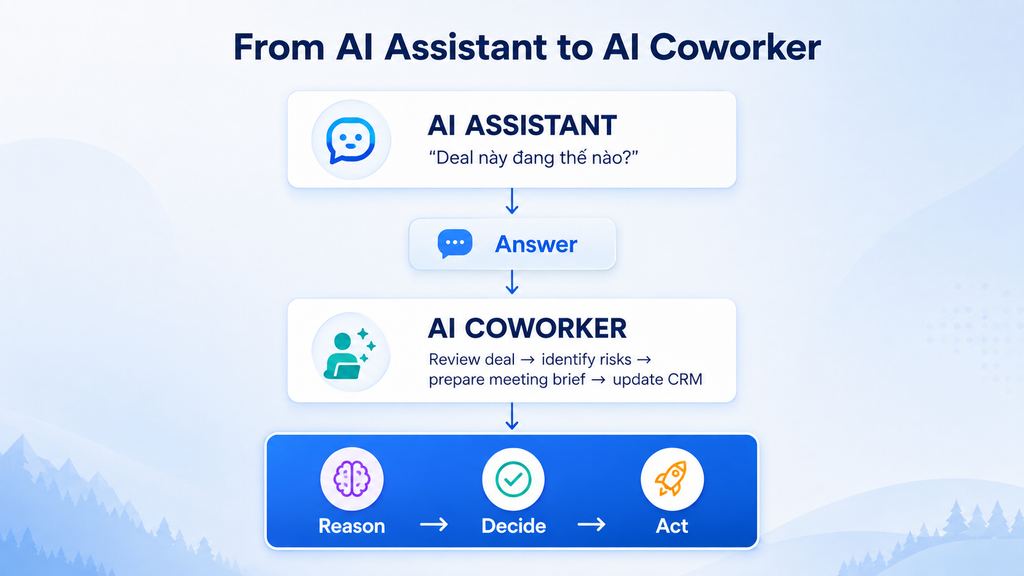
3. Từ AI Assistant đến AI Coworker
3. From AI Assistant to AI Coworker
This is perhaps the simplest way to picture the shift Claudeforce is aiming for.
AI Assistant
Sales asks: “What’s the status of this opportunity?”
AI answers: “The opportunity is at stage X, worth Y, and expected to close by Z.”
In this case, the AI mainly helps find and summarize information.
AI Coworker
Sales makes a different kind of request: “Review this opportunity, identify the risks, prepare a meeting brief, and update the CRM based on the actions I’m allowed to take.”
Here, the AI needs to go through more steps:
Understand → Reason → Decide → Act
This is the shift from AI supporting the work to AI participating in the work.
And once AI starts participating in business processes, the important question is no longer simply:
“Which model is the smartest?”
It becomes: “What is the AI allowed to do, based on what data, and within which business rules?”
That’s why governance becomes an important part of the Agentic AI story.
4. Claude Inside Salesforce: Reasoning Flows the Other Way Too
Claudeforce doesn’t just bring Salesforce into Claude.
In the other direction, Claude is also being brought into the Salesforce ecosystem to power AI and agentic experiences on the platform.
Salesforce says Claude is used as a reasoning model for the Atlas Reasoning Engine and supports experiences such as:
| Surface | What Claude does there | Status |
|---|---|---|
| Atlas Reasoning Engine | Available as a reasoning model powering agent plan-and-act loops | Available |
| Agentforce Vibes | Default model in the Vibes IDE | Default |
| Agentforce Coworker | Default model | Default |
| Agent Builder | Selectable model option when configuring agents | Available |
This creates a two-way model.
Salesforce → Claude
Data and business context are delivered to wherever the AI is reasoning.
Claude → Salesforce
Reasoning capability is fed back into the workflows and AI experiences running inside Salesforce.
So Claudeforce isn’t simply connecting two products.
It represents an approach where an AI model and an enterprise platform reinforce each other to bring AI deeper into real work.
5. Slack Brings Agentic AI into the “Flow of Work”
The CRM is where a business stores its data.
But work doesn’t only happen inside the CRM.
A decision can start from a conversation on Slack.
Sales talks with a manager. A customer issue gets discussed in a channel. An opportunity comes up in a meeting.
Afterward, the employee still has to go back to Salesforce to find the data and take action.
That’s exactly the gap between conversation and the business system.
Claudeforce aims to close that gap by connecting Claude with Salesforce and Slack. Salesforce says Claude powers a Slackbot for Salesforce customers and employees, bringing reasoning into where the work is actually happening.
The workflow can be pictured as follows:
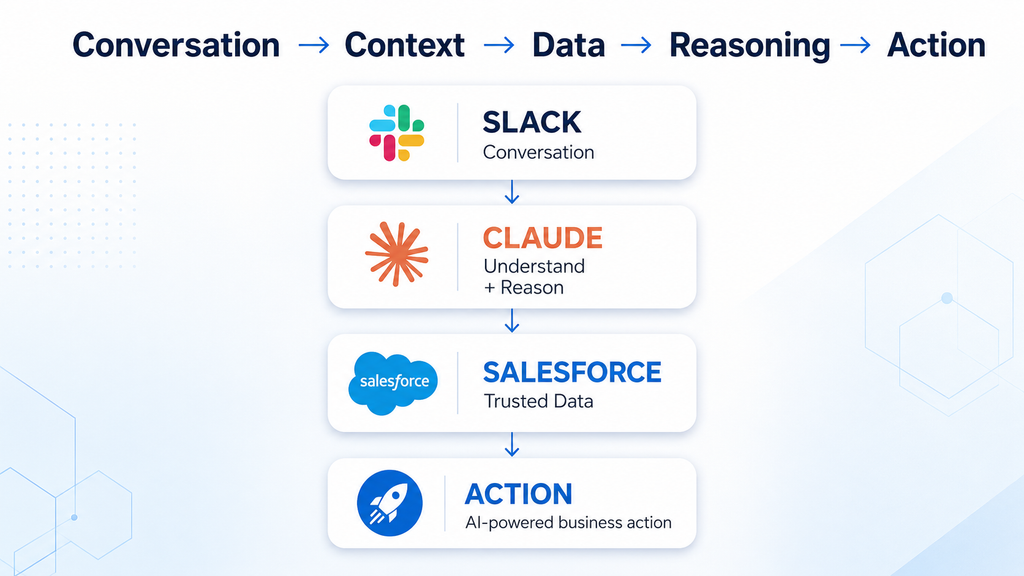
The key point is that AI no longer has to stand outside the workflow.
AI starts to become part of the workflow.
6. What Businesses Actually Get from Claudeforce
It’s not just a better chatbot.
The bigger value lies in shortening the gap between:
Information → Decision → Action
Consider a typical day in the life of a salesperson.
A significant amount of time can be spent on:
- Finding customer data
- Piecing together interaction history
- Checking opportunities
- Analyzing pipeline
- Preparing for meetings
- Updating the CRM
These are all necessary tasks, but they don’t always create the highest value.
If AI can support these tasks right within the flow of work, salespeople can spend more time on the work where humans create the most value:
Understanding customers. Building relationships. Making decisions. Closing deals.
So the Claudeforce story isn’t simply:”AI is getting smarter.”
It’s: AI becomes more useful when it’s connected to the right data, the right context, and the right workflow.
7. Enterprise AI Doesn’t Start with the AI Model
This is perhaps the most important insight businesses can take away from Claudeforce.
A powerful AI model is not enough.
For AI to create business value, a business needs, at the same time:
- AI Intelligence
- Trusted Data
- Business Context
- Workflow
- Business Rules
- Governance
If the CRM holds inaccurate data, workflows aren’t standardized, or access permissions aren’t clearly defined, then no matter how strong the AI’s reasoning is, it will struggle to produce reliable results.
Which is why: Agentic AI doesn’t start with choosing an AI model. It starts with how ready the business is for AI.
This is why CRM, Data, Workflow, and Governance will increasingly become the foundation of an enterprise AI strategy.Đây là lý do CRM, Data, Workflow và Governance sẽ ngày càng trở thành nền tảng của chiến lược AI doanh nghiệp.
8. Is Claudeforce Available Yet?
At this point in time, Salesforce in Claude is being made available to a number of pilot customers, and Salesforce plans to open a broader beta in September 2026.
Salesforce also says it will continue expanding skills and capabilities going forward.
That means Claudeforce is still in its early stages.
But the direction is already fairly clear:
AI will not just sit alongside enterprise software to answer questions. AI is moving directly into a business’s data, workflows, and business processes.
References: Salesforce — Claudeforce , Salesforce Newsroom — Claudeforce & Agentic Enterprise
9. Doanh nghiệp nên chuẩn bị gì cho Agentic AI?
9. What Should Businesses Prepare for Agentic AI?
Instead of just asking: “Should we use AI?”
businesses should start with a different question:
“If AI could take action on our systems, what should it be allowed to do?”
From there, businesses need to look back at some foundational factors:
- Is CRM data accurate and consistent enough?
- Have the important workflows been standardized?
- Are business rules clearly defined?
- Is data access set up appropriately?
- Which actions can AI carry out on its own?
- Which actions require human approval?
This is exactly the shift from AI adoption to AI readiness.
10. Powerful AI Needs a Strong Enterprise Foundation
Claudeforce makes one thing clear:
A powerful AI model is not enough.
For Agentic AI to create real business value, a business needs trusted data, clear processes, connected systems, and strong governance.
At Nimbus Consulting, we conduct a comprehensive assessment across:
Business Model → Processes → Data → Technology → User Needs
From there, we help businesses identify the right use cases, workflows, and roadmap for deploying Agentic AI in a way that fits their business goals.
Is your business ready for Agentic AI?
Not about putting AI everywhere.
About putting AI where it actually creates value.
→ Start your Agentic AI Readiness Assessment with Nimbus Consulting
(+84) 812 014 918
68 Bát Nàn, Phường Bình Trưng, TP. HCM, Việt Nam
 Ho Chi Minh City Office: 68 Bat Ban, Binh Trung Ward, Ho Chi Minh City