If your organization is struggling with buried messages, scattered information across multiple platforms, or spending too much time searching for files and conversation history, it may be time to adopt a more efficient way of working.
That is also why more businesses are asking: What is Slack? How does Slack work, and why is it used by millions of organizations worldwide as a collaboration hub for the entire business?
Unlike traditional messaging applications, Slack was built with the goal of bringing people, data, and workflows together on a single platform.
What Is Slack? How Does Slack Work?
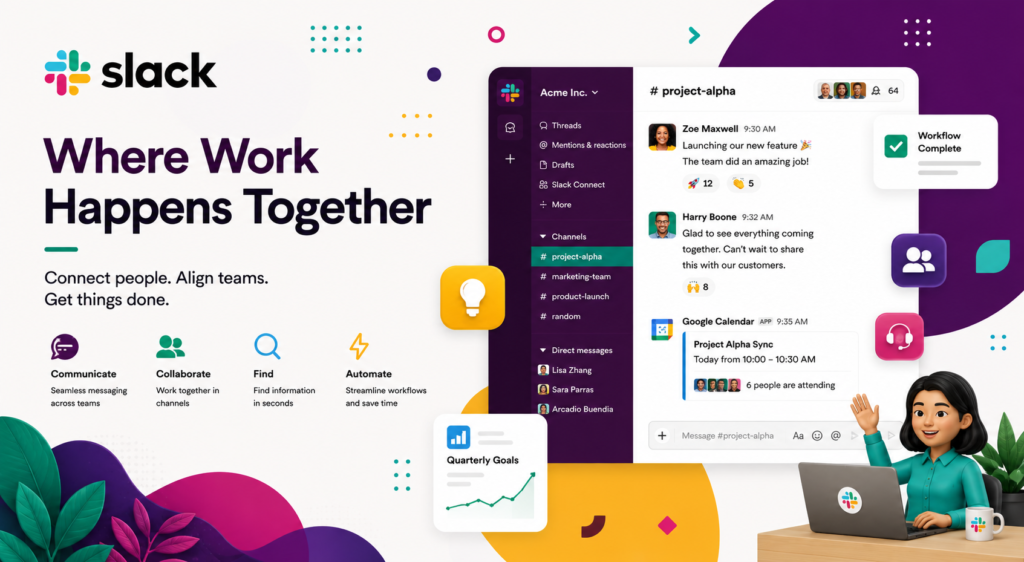
Slack is a business collaboration platform that enables teams to communicate, share information, and collaborate within a single digital workspace.
Instead of organizing information through isolated conversations, Slack uses Channels to categorize discussions by department, project, or customer.
A typical Slack workspace includes:
- Channels organized by department or project.
- Direct and group messages.
- Conversation history and shared files.
- Integrations with applications such as Google Drive, Zoom, Jira, and Salesforce.
As a result, Slack is more than just a chat application—it serves as an operational hub for modern businesses. Once organizations understand what Slack is, many realize that it is not simply a messaging tool, but a platform designed to centralize information and improve cross-functional collaboration.
Why Are More Businesses Moving from Zalo and Messenger to Slack?
Zalo and Messenger are widely used communication tools in Vietnam, but as businesses grow, these platforms often reveal several limitations.
Separate Work from Personal Life
Employees no longer need to use personal accounts for work communication. All business conversations and information are managed within a shared workspace.
Powerful Search Capabilities
Slack allows users to search for messages, files, or team members within seconds, instead of scrolling through thousands of old conversations.
Better File Management
Documents are stored centrally, reducing the risk of losing files or sending outdated versions.
Support for Remote and Distributed Teams
Slack enables teams in different locations to collaborate effectively and stay aligned.
These advantages are also why more Vietnamese businesses are becoming interested in the question, “What is Slack?” when searching for professional internal communication solutions.
Key Slack Features That Help Optimize Business Operations
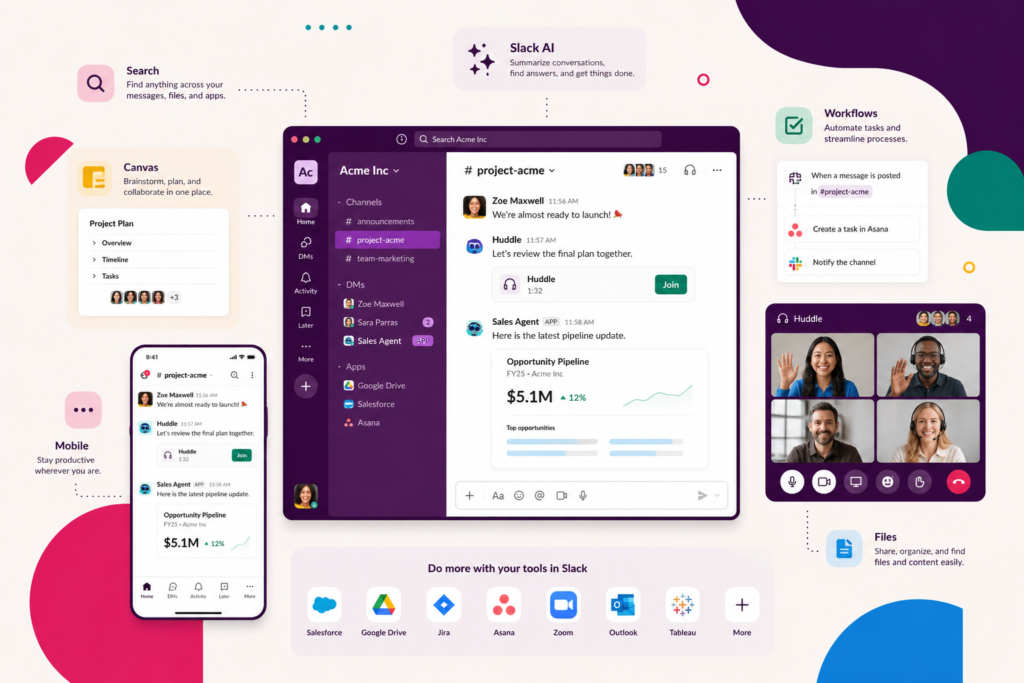
Channels – Organize Work by Teams
Organizations can create dedicated Channels for departments, projects, or customers to keep information structured and easy to manage.
Threads – Eliminate Message Clutter
Threads allow discussions to take place around specific topics without disrupting the main channel, making conversations easier to follow.
Huddles and Clips
Users can launch quick audio conversations or share short video clips without creating separate Zoom meetings.
Slack AI
Slack AI helps users search for information, summarize conversations, and enable employees to complete tasks more efficiently.
Reference: Slack AI Features
Canvas and Lists
Canvas centralizes team knowledge and documentation, while Lists help teams manage tasks directly within Slack.
Workflow Automation
Slack enables teams to automate simple business processes without writing code.
Powerful Integrations
Slack integrates with:
- Google Drive
- Microsoft 365
- Zoom
- Jira
- Notion
- Salesforce CRM
These integrations help businesses build a unified digital ecosystem.
Learn more: Slack Features
Can Slack Replace Internal Email and Messaging Apps?
For many organizations, the answer is yes.
| Criteria | Zalo | Slack | |
|---|---|---|---|
| Group chat | ❌ | ✅ | ✅ |
| Information search | ⚠️ | ⚠️ | ✅ |
| File management | ⚠️ | ⚠️ | ✅ |
| Project-based organization | ❌ | ⚠️ | ✅ |
| CRM integration | ❌ | ❌ | ✅ |
| Automation | ❌ | ❌ | ✅ |
| AI capabilities | ❌ | ❌ | ✅ |
Slack was not designed to replace email entirely, but it can significantly reduce internal email traffic and create a more efficient collaboration environment.
Advantages and Limitations of Slack
Advantages
- Centralized communication.
- Fast and powerful search capabilities.
- Integration with thousands of applications.
- AI and automation capabilities.
- Ideal for remote and hybrid work environments.
Limitations
- Employees may need time to adapt.
- Organizations should establish clear usage guidelines.
- Some advanced features are only available in paid plans.
Which Businesses Are Best Suited for Slack?
Beyond understanding what Slack is, many leaders also want to know whether the platform fits their organization’s size and operating model.
Slack is particularly suitable for:
- Fast-growing startups.
- Small and medium-sized businesses.
- Technology companies.
- Professional service firms.
- Remote and distributed teams.
- Organizations already using Salesforce CRM.
If your business needs better collaboration and wants to eliminate data silos, Slack is worth considering.
Slack Is More Than a Chat Application: Digital HQ for Modern Businesses
Today, Slack is becoming the operational center for many modern organizations.
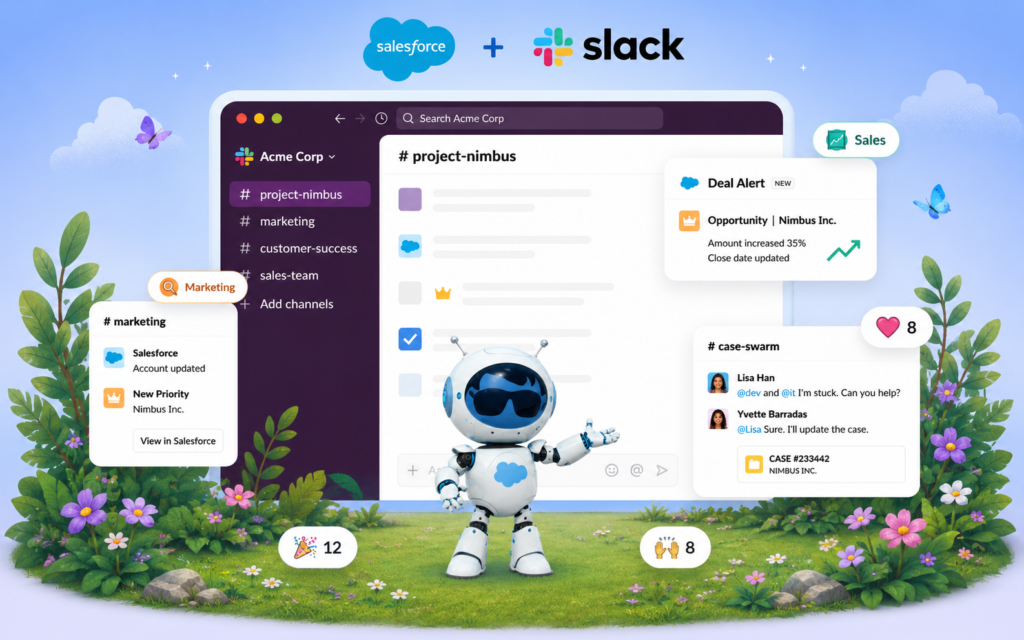
Through deep integration with Salesforce CRM, business data and processes can work together seamlessly.
For example:
A new lead is created in Salesforce CRM
↓
Slack automatically sends a notification to the Sales team
↓
A salesperson picks up the opportunity
↓
An AI Agent assists with processing information
↓
Customer engagement happens faster and more efficiently
This is one reason Salesforce refers to Slack as a Digital HQ—a place where people, data, and workflows come together on a single platform.
Following the acquisition of Slack in 2021, Salesforce positioned Slack as the Digital HQ for enterprises, connecting people, data, and workflows across the organization.
Read more: Salesforce Completes Acquisition of Slack
Conclusion
So, what is Slack?
Slack is much more than a business messaging application. It is a collaboration platform that helps organizations centralize information, connect teams, and optimize workflows.
When combined with Salesforce CRM, AI, and other business applications, Slack can become the operational hub for businesses in the digital era.
Ready to Build a Digital Workspace for Your Business?
Nimbus Consulting helps organizations implement and optimize Salesforce and Slack ecosystems to improve collaboration and automate business processes.
Contact the Nimbus team to discover the right solution for your organization.
Hotline: (+84) 812 014 918
Website: nimbus-consult.vn
👉 Schedule a Slack and Salesforce Consultation
Frequently Asked Questions
Is Slack free?
Yes. Slack offers a free plan as well as several paid plans designed to fit businesses of different sizes.
How is Slack different from Zalo?
Slack is designed specifically for businesses, offering stronger search capabilities, centralized information management, and extensive integrations.
Is Slack suitable for small businesses?
Yes. Slack is suitable for startups, small and medium-sized businesses, as well as large enterprises.
Can Slack integrate with Salesforce?
Yes. Slack is part of the Salesforce ecosystem and offers deep integration with Salesforce CRM.