As a business grows, customer data increases — and becomes increasingly difficult to manage
But having more data does not necessarily mean having enough Visibility to make informed decisions.
The CEO still has to ask :
“Where is the Pipeline this month ?”
Sales has to check Excel, email, and multiple systems to update Opportunities
Marketing does not know which Leads have been followed up by Sales
Customer Service has to search through interaction history before supporting a customer
At that point, the problem is no longer just about Data.
It is about Visibility, Process, and how the business manages the Customer Journey.
This is when businesses should ask :
What business problems can Salesforce CRM solve — and does your business really need it?
1. What is Salesforce CRM ?
CRM (Customer Relationship Management) is a system used to manage all interactions between a business and its current and potential customers. The goal is simple: improve customer relationships to drive business growth. CRM technology helps companies maintain customer connections, streamline processes, and improve profitability.
Instead of customer data being scattered across different teams, Salesforce CRM helps businesses build a unified Customer View throughout the Customer Journey :
Lead → Sales → Customer → Service → Retention → Growth
Businesses can manage :
- Leads, Accounts, Contacts
- Opportunities and Sales Pipeline
- Customer interactions
- Service Cases
- Reports & Dashboards
- Automation
- Integration
- Analytics & AI
But the value of Salesforce CRM does not lie in the number of features.
The value lies in its ability to transform :
Data → Insight → Action → Business Outcome
2. What is Salesforce CRM used for ?
Sales — Managing the Pipeline
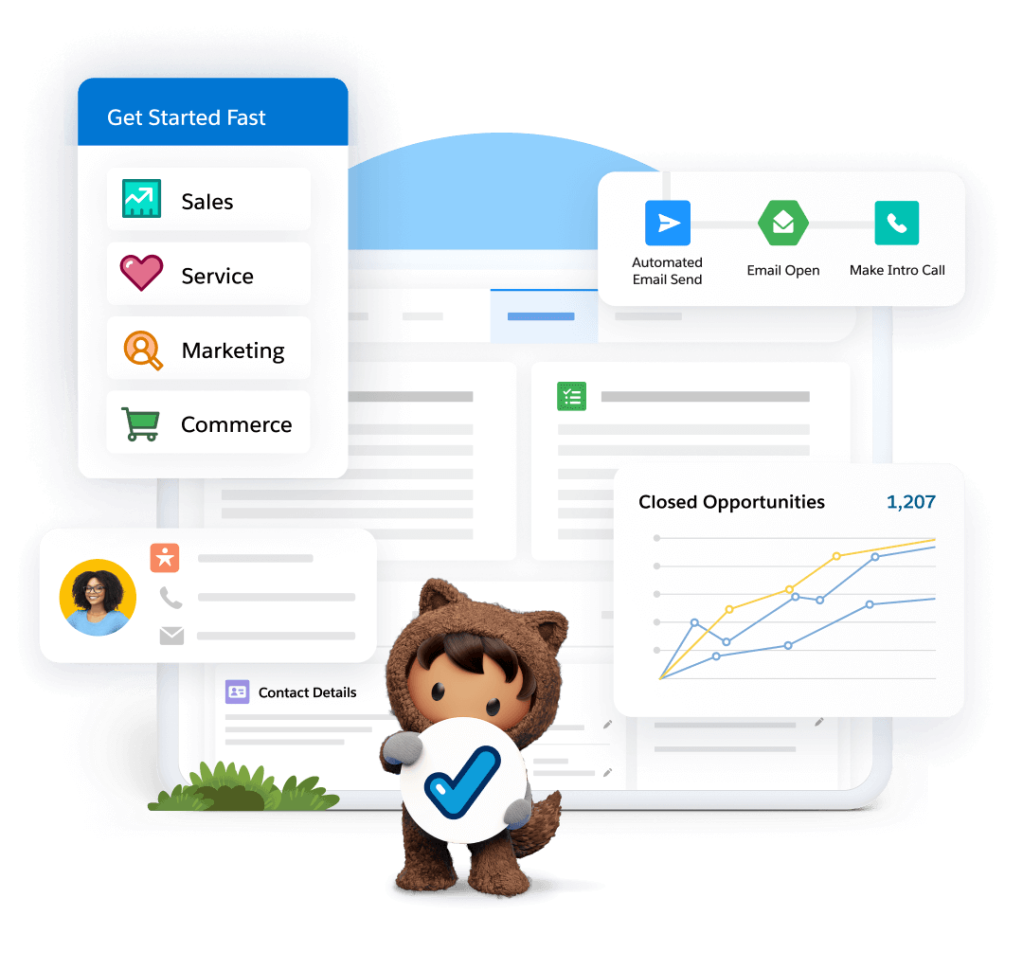
Salesforce CRM helps Sales teams manage Leads, Opportunities, Sales Stages, Activities, Forecasts, and Pipelines in one system.
Management can track :
Pipeline → Forecast → Expected Revenue
instead of waiting for Sales to manually consolidate reports.
Marketing — Connecting Leads with Sales
Marketing can understand :
- Where did the Lead come from ?
- Has the Lead been followed up by Sales ?
- What stage is the Lead currently in ?
- Has the Lead become an Opportunity ?
This creates a connected flow :
Marketing → Lead → Sales → Opportunity → Customer
Customer Service — Having Full Customer Context
Customer Service can access the Customer Profile, Interaction History, Service History, and other relevant information to support customers faster and more consistently.
Automation, Integration & AI
As Business Processes become more complex, Salesforce CRM can support Automation, connect with other systems, and leverage AI to :
- Reduce manual work
- Connect data
- Find information
- Summarize customer history
- Support Insights and Next Actions
3. What problems does Salesforce CRM solve ?
Customer Data is fragmented
Data is spread across :
Excel + Email + Website + Marketing Tools + Sales Tools
→ Making it difficult to build a unified Customer View.
Management lacks Visibility
Pipeline and Forecast depend on manual reporting
→ Decisions become slower, and it is harder to see the complete Business Picture.
Business Processes are becoming more complex
Lead Assignment, Approval, Follow-up, or Customer Service Escalation involve too many manual steps
→ This takes time, increases the risk of errors, and makes it difficult to scale operations while maintaining efficiency.
Teams work in “Silos”
Marketing, Sales, and Service each see only part of the Customer Journey
→ Customers may have to provide the same information repeatedly, resulting in an inconsistent experience.
Salesforce CRM aims to connect :
Data + People + Process + Technology
into a more unified operating system for the business.
Source: Salesforce
4. 7 signs your business should reassess its CRM
A business does not have to be large before it needs a CRM
Start evaluating your CRM when :
- The CEO has to ask Sales to find out where the Pipeline stands.
- Customer data is scattered across multiple systems.
- Marketing does not know how far Leads have progressed through the Sales process.
- Sales spends too much time on Reporting and data updates.
- The Sales Process involves multiple Approval, Assignment, and Follow-up steps.
- The business needs to connect its Website, ERP, Marketing Platform, or internal systems.
- The business is expanding and disconnected tools are becoming a bottleneck in operations.
Business Complexity matters more than Business Size when choosing a CRM.
5. Is Salesforce CRM the right choice ?
Not every business needs Salesforce CRM
If customer data and Sales Processes are still simple, and the business does not require extensive Integration, a simpler CRM may be a better fit.
On the other hand, Salesforce CRM may be worth considering when a business has :
- Multiple teams working with customers.
- Increasingly complex Sales Processes.
- Customer data coming from multiple sources.
- A need for Automation and Integration.
- A need for Analytics and Reporting.
- Plans to scale the business.
The key question is not :
“Does Salesforce have more features ?”
But :
“Does the business complexity require a scalable CRM platform?”
6. Don’t start with Technology. Start with the Business
A common mistake when exploring Salesforce CRM is asking :
“What features does Salesforce have ?”
The question should be :
“What business problems do we need to solve ?”
At Nimbus Consulting, CRM Assessment follows the framework :
Business → Process → Data → Technology → People
From there, we identify :
Business Problem → CRM Requirements → Salesforce Solution → Roadmap
Businesses can gain a clearer understanding of :
- The current state of CRM and Customer Data
- Bottlenecks in Business Processes
- Opportunities for Automation and Integration
- Whether Salesforce is truly the right fit
- What should be prioritized first
CRM Implementation is not just a Technology Project.
It is a Business Transformation Initiative.
Is Salesforce CRM right for your business ?
Don’t start with :
“What features does Salesforce CRM have ?”
Start with :
“Where is the business losing Visibility, time, or Business Opportunities ?”
If Customer Data is fragmented, the Pipeline is difficult to see, Business Processes are becoming increasingly complex, or teams do not have a unified Customer View, it may be time to reassess your CRM Strategy.
Salesforce Consulting & CRM Assessment with Nimbus Consulting
As a Salesforce Consulting Partner, Nimbus Consulting helps businesses assess their current state, define CRM Requirements, and recommend Salesforce solutions that fit their business needs.
Our approach :
Business Problem → CRM Assessment → Salesforce Solution → Implementation Roadmap
CRM Assessment helps businesses determine :
- Whether Salesforce truly fits their Business Requirements
- Which problems should be prioritized
- Which Processes can be automated
- Which systems need Integration
- Where to start with Salesforce Implementation
The goal is not to implement as many Salesforce Features as possible
The goal is to build a Salesforce Solution that fits the business and creates Measurable Business Value.
→ Register for a Salesforce CRM Assessment
Find out whether Salesforce is right for your business and where to start.
Business First. Technology Second.
Hotline: (+84) 812 014 918
Website: nimbus-consult.vn