

Picture this: your sales representative has just opened Salesforce on a Monday morning. Instead of scrolling through hundreds of leads to guess who is worth following up with, the system has automatically ranked each opportunity based on the probability of closing the deal. A personalized follow-up email has already been drafted and is ready to be sent with just one click. What about the customer support case opened last night? A proposed response is already waiting in the agent’s inbox.
This is not a futuristic vision. This is Salesforce Einstein, the AI layer deeply integrated into the entire Salesforce CRM platform, working every day for tens of thousands of businesses globally.
This article will decode the full power of Salesforce Einstein AI in CRM management: from its history and operating mechanisms to its core features across different Clouds, and the most practical question—how should Vietnamese businesses implement Einstein to achieve the best ROI?
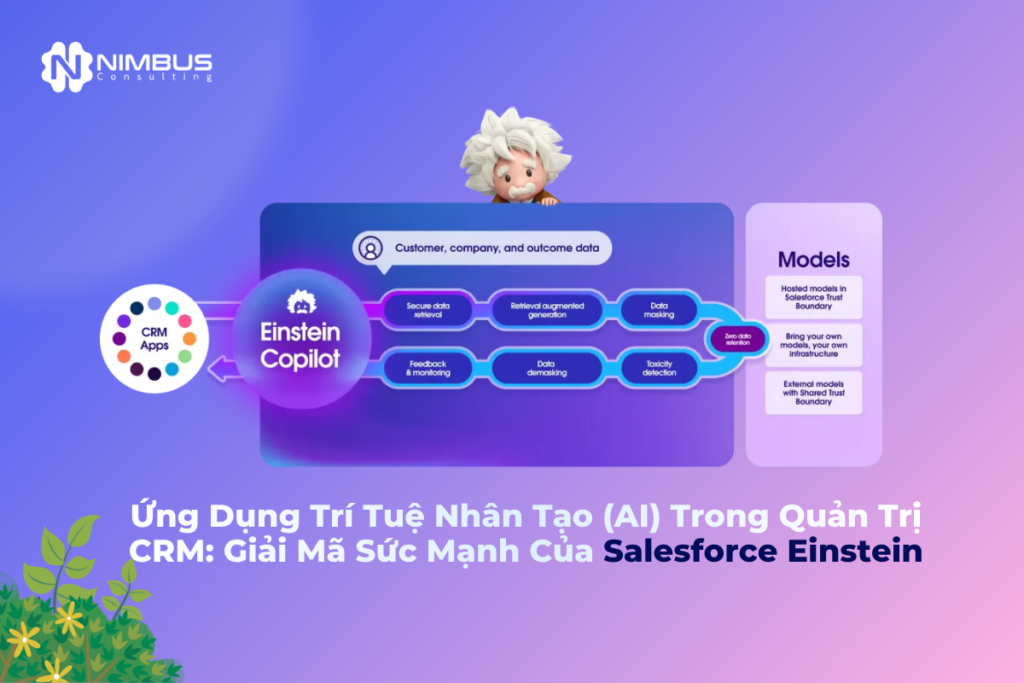
Source: Salesforce — Einstein 1 Platform, the AI platform integrated across the entire CRM ecosystem.
1. What is Salesforce Einstein AI? – The Accurate Definition for 2026
Salesforce Einstein is not a standalone product that you can purchase separately and install into your system. This is a common misconception among businesses when first exploring AI in Salesforce.
Einstein is the AI layer deeply integrated into the entire Salesforce ecosystem – from Sales Cloud, Service Cloud, and Marketing Cloud to Commerce Cloud and Slack.
In other words, Einstein is the smart “brain” running in the background of your CRM, continuously learning from data to provide insights, predictions, and personalized content directly within your daily workflow. According to the official definition from Salesforce, Einstein consists of three complementary AI layers:
| AI Type | Function | Practical Example |
| Predictive AI | Analyzes historical data to forecast outcomes | Lead Scoring, Opportunity Scoring, Forecast |
| Generative AI | Creates new content based on CRM data | Drafting emails, summarizing cases, proposing responses |
| Agentic AI | Autonomously plans and executes multi-step workflows | Agentforce (see Section 9) |
The biggest difference compared to external AI tools like ChatGPT or Gemini is that Einstein is “fed” with your business’s actual CRM data. Every insight and prediction is based on transaction history, customer behavior, emails, and calls—not generic data.
2. History: From Machine Learning in 2016 to Generative AI
To understand where Einstein stands in 2026, we need to look back at its developmental journey:
- 2016 – Einstein’s First Launch: Salesforce introduced Einstein with basic machine learning features: lead scoring, opportunity insights, and Einstein analytics. This was the first predictive AI layer natively integrated into the CRM.
- 2023 – Einstein GPT at TrailblazerDX: This was the biggest turning point. Salesforce announced Einstein GPT, integrating generative AI capabilities into the CRM. Einstein GPT combines three sources: Salesforce’s internal AI models, ChatGPT technology through a partnership with OpenAI, and a “bring your own model” capability for businesses wanting to use their own models.
- 2024 – Einstein Copilot & Agentforce: Salesforce launched Einstein Copilot (a conversational AI assistant right inside the CRM) and Agentforce (autonomous AI agents) at Dreamforce 2024.
- 2025-2026 – Einstein 1 Platform & Deeper Integration: Einstein was upgraded to Einstein 1, tightly integrated with Data Cloud to provide AI based on unified customer data, while enhancing automation capabilities through Einstein for Flow.
3. Einstein Trust Layer: The “Shield” Protecting Enterprise Data
One of the biggest barriers when businesses deploy AI in their CRM is the question: “Will our customer data be exposed?”
Salesforce addresses this issue with the Einstein Trust Layer—a security and AI governance framework operating behind the scenes in all Einstein features. Specifically, the Trust Layer:
- Prevents the LLM from retaining sensitive customer data after processing (data is not “learned” into the external model).
- Masks personally identifiable information (data masking) before sending prompts to any LLM.
- Ensures the AI responds based on the business’s own data, not generic information from the internet.
- Provides a complete audit log for every action performed by the AI—especially crucial for businesses in finance, healthcare, and heavily regulated industries.
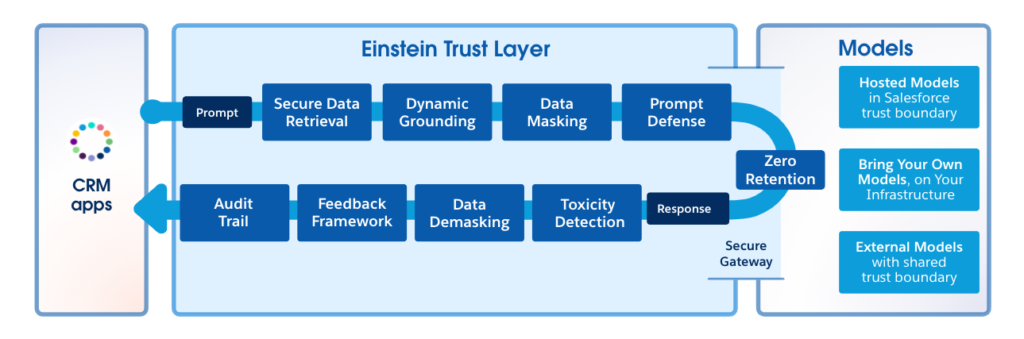
Source: Salesforce Developers Blog — How the Einstein Trust Layer protects sensitive data before it is sent to the LLM.
This is a capability that many external AI tools cannot provide — and it is the reason why many enterprises choose Einstein over manually integrating ChatGPT into their CRM
4. Overview of Salesforce Einstein Features by Cloud
Einstein is not a single feature but a suite of tools spread across the entire Salesforce ecosystem. Below is the big picture before diving into each Cloud:
| Cloud | Key Einstein Features |
| Sales Cloud | Lead Scoring, Opportunity Scoring, Einstein Copilot, Sales Emails, Call Summaries, Next Best Action |
| Service Cloud | Einstein Bots, Case Classification, Smart Replies, Article Recommendations, Field Service Intelligence |
| Marketing & Commerce Cloud | Predictive Segmentation, Send-Time Optimization, Engagement Scoring, Content Personalization, Product Recommendations, Search Personalization, Abandoned Cart Intelligence |
| Platform/All | Einstein Analytics (CRM Analytics), Prediction Builder, Model Builder, Prompt Builder |
5. Einstein for Sales Cloud: AI for the Sales Team
This is where Einstein creates the most obvious value and is most commonly deployed. If your sales team is complaining about “not knowing which deals to focus on” or “spending too much time drafting emails,” this is the answer.
Einstein Lead Scoring
Scores each lead on a scale of 1-99 based on the likelihood of conversion, analyzing dozens of factors: email engagement history, website behavior, demographic information, and patterns from previously successful deals.
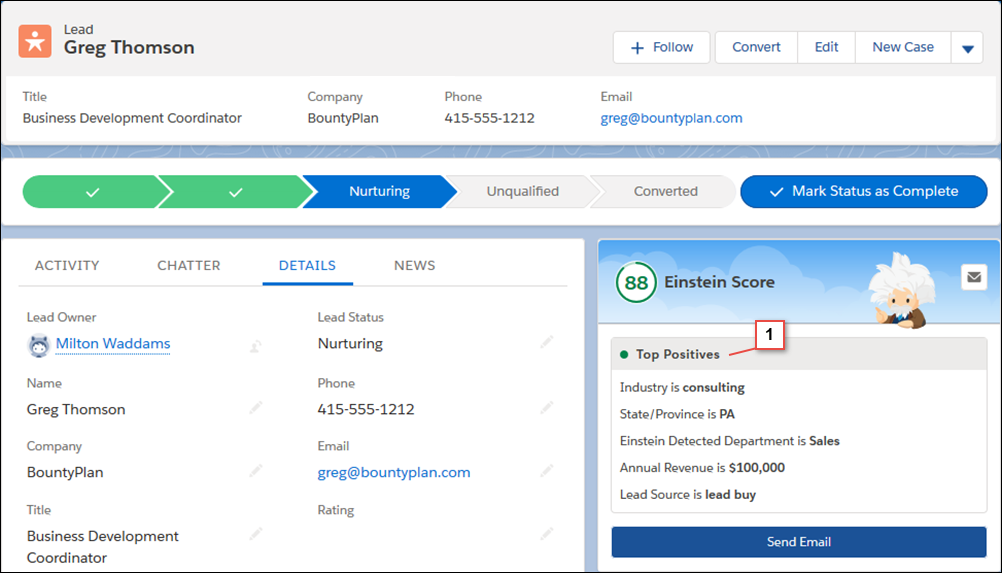
Source: Salesforce — Einstein Lead Scoring helps sales teams focus on the right leads with the highest potential.
An important point to understand is that this scoring model is trained exclusively on your business’s historical data, not generic data. This means the lead scoring for a B2B SaaS company will be very different from a consumer goods distributor, and Einstein will learn from the unique characteristics of each business.
Einstein Opportunity Scoring
Similar to Lead Scoring, but applied to Opportunities (sales deals currently in the pipeline). Einstein evaluates the “health” of each deal and alerts you when there are signs of risk (for example: no customer interaction in 2 weeks, or a deal that is overdue compared to the expected close date).
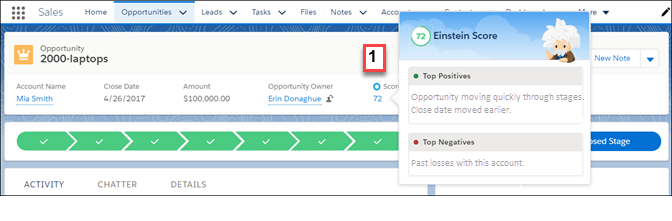
Source: Peeklogic — Einstein Opportunity Scoring displays directly on the record, helping sales managers identify which deals require intervention.
Sales managers can look at the dashboard once and instantly know which deals require intervention and which ones are tracking well.
Einstein Sales Emails & Call Summaries
- Sales Emails: Automatically drafts personalized follow-up emails for each customer, based on the entire interaction history within the CRM. Employees simply need to review and send.
- Call Summaries: Automatically records, transcribes, and summarizes sales calls, then suggests the next actionable steps. No more scenes of employees taking manual notes while on a call.
Next Best Action (NBA)
Recommends the best next action for sales representatives based on the current context of the deal. For example: “This customer just viewed the pricing page 3 times in the last week; this is a good time to send a proposal.”
📌 Read more: Salesforce Sales Cloud Và Nghịch Lý: Đầu Tư CRM Nhưng Vẫn Dùng Excel — Why do many businesses have Salesforce but still cannot fully leverage AI value?
6. Einstein for Service Cloud: AI for Customer Support
The support department is usually where AI creates the fastest and most measurable impact, as the work is highly repetitive and high-volume.
Einstein Bots
AI chatbots that can automatically handle frequently asked questions 24/7 across web chat, WhatsApp, SMS, and other messaging channels. Unlike traditional rule-based chatbots, Einstein Bots are trained using NLP (Natural Language Processing) and can understand customer intent even when questions are poorly written.
When an issue exceeds the Bot’s capabilities, the system automatically escalates it to a human agent along with the complete conversation history—preventing the customer from having to repeat themselves.
Einstein Case Classification
Automatically classifies tickets as soon as they enter the system, based on the content and customer sentiment. It then routes the ticket to the right team and the suitably qualified agent, eliminating the need for agents to read and manually classify them.
Einstein Smart Replies & Article Recommendations
- Smart Replies: When an agent is handling a case, Einstein analyzes the content and suggests readily available responses. The agent can use them as-is or edit them.
- Article Recommendations: Automatically suggests Knowledge Base articles relevant to each case, helping agents respond faster and more accurately.
📌 Read more: Salesforce Service Cloud Là Gì? Hướng Dẫn Chi Tiết Cho Doanh Nghiệp Việt Nam 2026 — Discover the entire Service Cloud before deploying Einstein for Service.
7. Einstein for Marketing Cloud: AI for Marketing Campaigns
Marketing Cloud Einstein brings AI into every stage of the marketing campaign:
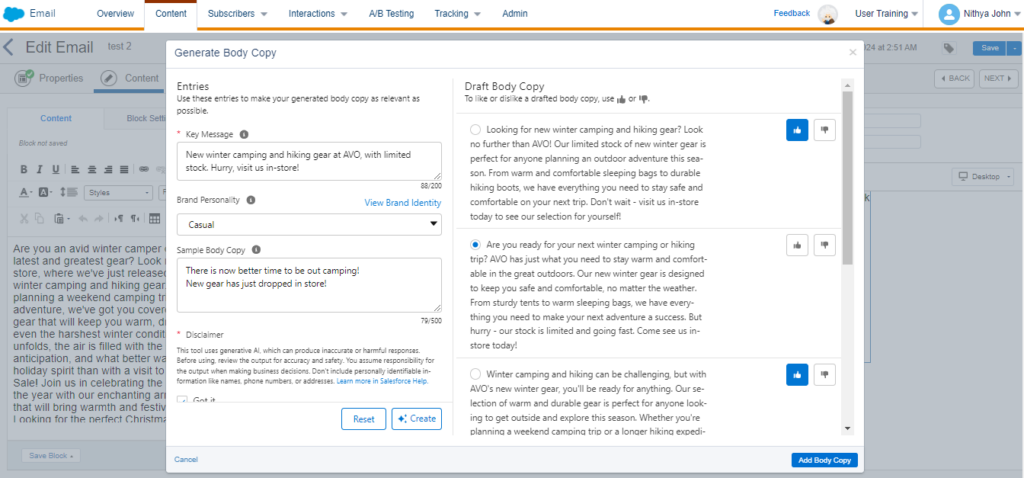
Source: ABSYZ — Einstein Marketing Cloud AI optimizes email content and send times for each customer.
Predictive Segmentation: Instead of manually segmenting based on rigid criteria (age, location), Einstein analyzes behavior and automatically groups customers based on their likelihood to respond to specific content types. You target the right people, resulting in lower media costs.
Send-Time Optimization: Analyzes the email opening history of each subscriber to determine the best time to send an email to each individual—not just a fixed time slot for the entire list. Analyzes the email opening history of each subscriber to determine the best time to send an email to each individual—not just a fixed time slot for the entire list.
Content Personalization: Einstein’s dynamic AI automatically selects the most suitable product images, headlines, and CTAs for each email recipient based on their interaction history and preferences.
Engagement Scoring: Scores the “engagement” level of each contact in the database, helping the marketing team identify who has gone cold and needs a re-engagement campaign.
8. Einstein GPT and Einstein Copilot: The New Generation of AI in CRM
While the aforementioned Einstein features are “background AI”, Einstein GPT and Einstein Copilot represent the AI layer that users interact with directly using natural language.
Einstein GPT
Launched at TrailblazerDX 2023, Einstein GPT allows users to type requests in natural language and receive auto-generated content—but it is “grounded” in the business’s actual CRM data, not generic information. Practical examples:
- “Draft a follow-up email for opportunity ABC based on yesterday’s call” → Einstein GPT generates an email specifically mentioning the call’s content, the products discussed, and suggesting appropriate next steps.
- “Summarize case #12345 for me” → Einstein GPT reads the entire case history and replies with 3–4 key points.
- “Create a Q1 pipeline report for the VP of Sales” → Einstein synthesizes data from the CRM into a narrative report.
Important technical note: Einstein GPT does not just use a single model. It allows choosing between Salesforce’s models, OpenAI’s models (via an official partnership), or the business’s own proprietary models—all protected by the Einstein Trust Layer.
Einstein Copilot
Einstein Copilot is a conversational AI assistant deeply embedded into the Salesforce interface, appearing as a side panel in Sales Cloud, Service Cloud, and even within Slack. Users can ask Copilot questions just like chatting with a colleague who understands the entire CRM data:
- “Which deals are at risk this week?”
- “How has Customer Company A interacted with us over the past 30 days?”
- “Create a new contact for the person who just filled out the website form.”
Copilot executes these actions directly within Salesforce, saving users from having to navigate through multiple pages or knowing exactly which records to update.
9. Salesforce Einstein vs. Agentforce: What’s the Difference?
This is the most common question in 2025-2026 as Salesforce rolls out Agentforce. Let’s clarify this once and for all:
Einstein is a smart assistant; it recommends, predicts, generates content, and supports human decision-making. The user remains the final decision-maker and executor.
Agentforce is an autonomous digital worker; it can execute multi-step workflows on its own without requiring human intervention at every step. Agentforce operates 24/7, processing multiple tasks simultaneously, and only escalates to a human when encountering situations that exceed its configured limits.
| Criteria | Einstein | Agentforce |
| Role | Assistant supporting humans | Autonomous digital worker |
| Automation Level | Recommends for human decision | Autonomously executes end-to-end workflows |
| Data Processing & Fit | Mostly structured CRM data. Boosts existing team productivity. | Both structured and unstructured data. Scales operations, reduces repetitive tasks. |
| Packaging | Mostly built-in within Sales/Service Cloud | Separate add-on, requires configuring Agent Topics & Actions |
These two products complement each other rather than replacing one another. A smart AI deployment roadmap typically begins with Einstein to increase team productivity, and then scales up to Agentforce once clean data and stable processes are established.
📌 Read more: Salesforce Einstein vs Agentforce: Nên Chọn Gì Cho CRM Của Bạn? (Cập nhật 2026) — Detailed comparison with pricing and selection guidelines from the Nimbus team.
10. Things to Consider Before Deploying Einstein
As a Salesforce Consulting Partner with hands-on deployment experience in Vietnam, Nimbus notes a few points that businesses are often not thoroughly advised on before starting:
Einstein needs clean data to operate effectively. Lead Scoring cannot make accurate predictions if 40% of the leads in the system lack information or have incorrect data. The first step is always data auditing and cleansing—not immediately installing AI features.
Minimum data volume is crucial. Einstein’s predictive models need enough history to learn. For Lead Scoring, Salesforce recommends a minimum of 1,000 converted leads and 1,000 non-converted leads for the model to have sufficient training data. Small businesses just starting with Salesforce may need time to accumulate data before predictive features can operate optimally.
Your Salesforce edition affects the Einstein features you get. Certain features like Einstein GPT and Copilot are only available in Unlimited and Einstein 1 Editions. Before planning your deployment, carefully review your current package and what upgrades might be needed.
Change management and staff training are mandatory. AI does not replace processes; it amplifies both good and bad processes. If the sales team is not in the habit of entering data into Salesforce, Einstein will have nothing to learn from or analyze.
📌 Read more: Sự Thật Về Salesforce CRM: Giải Mã Bài Toán Triển Khai Salesforce Ít Rủi Ro Nhất — Truths that few partners will tell you straight before signing a contract.
11. Practical Einstein Deployment Roadmap for Vietnamese Businesses
Based on practical deployment experience across Financial Services, Real Estate, Logistics, and High-tech industries in Vietnam, Nimbus recommends a 3-phase roadmap:
Phase 1: Foundation (Months 1-2) – Data & CRM Hygiene
Before enabling any Einstein features, you must ensure:
- Audit and standardize existing data in Salesforce
- Standardize data entry processes and data governance
- Train staff on the importance of data quality
- Review the current Salesforce package to plan for upgrades if necessary.
Phase 2: Quick Wins (Months 3-4) – Basic Einstein Features
Start with easy-to-deploy features that show quick results:
- Implement Einstein Lead Scoring for the sales team (if there is sufficient data volume)
- Einstein Bots for basic support (FAQ automation)
- Einstein Activity Capture to automatically log emails and events into the CRM
- Remember to measure baseline metrics: case resolution time, lead conversion rates, and email drafting time.
Phase 3: Scale (Month 5+) – Einstein GPT & Advanced Features
Once the team is accustomed to the platform, you can:
- Deploy Einstein Copilot for the entire sales and service teams
- Integrate Sales Emails and Call Summaries
- Implement Next Best Action for more complex workflows
- Evaluate ROI to consider Agentforce for highly automated use cases.
12. Nimbus Consulting: Your Salesforce Einstein Deployment Partner in Vietnam
Nimbus Consulting is an official Salesforce Consulting Partner with a team of 12+ Salesforce-certified experts, including specialized certifications in Einstein Analytics, Sales Cloud, and Service Cloud.
We have helped numerous businesses in Vietnam, ranging from high-tech startups to financial corporations, implement Salesforce Einstein effectively with measurable ROI.
Nimbus can assist you with:
- Free CRM Audit: Assessing your current data and Salesforce infrastructure to determine the most suitable Einstein features—at no cost.
- Einstein Readiness Assessment: Checking data quality, volume, and Salesforce configurations to ensure Einstein functions accurately from day one.
- Deployment and Configuration: Setting up Lead Scoring, Opportunity Scoring, Einstein Bots, Copilot, and the full suite of Einstein features tailored to your specific needs.
- Team Training: Practical workshops helping your sales and support teams master Einstein within their daily workflows.
- Upgrade and Licensing Consultation: Guiding you to the appropriate package so you get the necessary Einstein capabilities without overpaying.
📌 Read more: Tư Vấn Triển Khai Salesforce: Tại Sao Nimbus Consulting Giúp Doanh Nghiệp Tiết Kiệm Hơn Tự Triển Khai?
Conclusion
Salesforce Einstein is not just a superficial add-on feature. For businesses already using Salesforce, Einstein represents the transition from a passive CRM (data storage) to a proactive CRM (generating insights and driving action), without requiring a complete system overhaul or retraining from scratch.
However, like any powerful tool, Einstein is only effective when deployed correctly: in the right sequence, with the right data, and by the right team. If you are considering integrating AI into your CRM, or are currently using Salesforce but haven’t fully leveraged Einstein, let Nimbus partner with you right from the initial assessment step.
📞 Contact Nimbus Consulting
Get free consultation on Salesforce Einstein for your business.
- Hotline: (+84) 812 014 918
- Email: info@nimbus-consult.vn
- Address: 68 Bat Nan, Binh Trung Ward, HCMC
- Website: nimbus-consult.vn
Nimbus Consulting – An official Salesforce Consulting Partner in Vietnam. We don’t just deploy Salesforce; we help you extract its full value.
 Ho Chi Minh City Office: 68 Bat Ban, Binh Trung Ward, Ho Chi Minh City